From August 1943 the Japanese government had its zoos kill their lions, tigers, bears and elephants, and the red pavilion in Fukuoka's Ohori Park is a surviving piece of one of those zoos.
The pavilion that came from a zoo
The red hexagonal pavilion on the island in Ohori Park, the Ukimi-do, was not built for the park: it was built for the seal pond of Fukuoka's first zoo. Ohori Park's official site says it stood at the fur seal pond of the zoo in East Park (Higashi Park) and was moved to Ohori in 1949. A Fukuoka City cultural-properties pamphlet describes it as a building for watching seals and other sea mammals, moved so it could be preserved, and registered as a city cultural property in 2014.
The zoo it came from lasted ten years and nine months. Fukuoka opened it in 1933, largely with citizens' donations, and closed it on May 20, 1944. On June 6, its lions, tigers and hippopotamus were destroyed.
That was not a local decision. It was Fukuoka's part of a national policy that very few people know about today, and the only book-length account in English is Mayumi Itoh's Japanese Wartime Zoo Policy: The Silent Victims of World War II (2010). This article follows her research on who gave the order, why, how the animals were killed, what the keepers and children did, and what is left in Fukuoka. It describes the killings in detail.
The order
The idea came from one man, Ōdachi Shigeo, the first governor-general of Tokyo, and it reached every zoo in Japan through the Home Ministry. Itoh writes that scholars, zoo directors and zoo specialists agree on this.
Ōdachi was a career Home Ministry bureaucrat who studied law at Tokyo Imperial University. He served as permanent vice home minister in 1939 and 1940, then as mayor of Singapore (renamed Shōnan) and Army administrator there in 1942. In July 1943 Tokyo city and Tokyo prefecture were merged into one metropolitan government to run the capital for the war, and he became its first governor-general. A year later he became home minister himself.
The Home Ministry ran local government and the police, including the special police who arrested people for failing to cooperate with the war effort. Zoo directors reported to park-section heads, who reported to Home Ministry bureaucrats. Itoh's point is that nobody in that chain could refuse an order without risking their position or worse.
The plan already on paper
In August 1941 the Army's eastern veterinary department asked Ueno Zoo for an air-raid contingency plan. The acting director, Fukuda Saburō, wrote an "Outline of Zoo Contingency Measures" that sorted animals into four classes by danger. Class A held bears, tigers, leopards, lions, hippopotamuses, American bison and Asian elephants, among others; Class B included fur seals and sea lions. It said that when air raids were imminent the zoo would poison dangerous animals with strychnine nitrate and cyanide, and shoot them if poison failed.
The plan was for the middle of a raid. Ōdachi turned it into something to do in advance.
Mid-August 1943
According to the journalist Takamiya Tahei's account, Ōdachi called in the Tokyo park-section head, Inoshita Kiyoshi, in mid-August 1943 and asked about the zoo. Inoshita said it was ready to poison the animals in an air raid and shoot them if needed. Ōdachi asked what would happen if people were hit before the animals, and Inoshita had no answer.
Ōdachi's reply, as Takamiya reports it, was that the animals would have to be destroyed sooner or later and it would be better to do it "in a clever fashion" now. The military and police might object if they found out in advance, he said, so Inoshita did not need to tell them. On August 16, Inoshita passed the order to Fukuda: destroy the dangerous animals within a month (Fukuda's journal elsewhere gives August 31). It was strictly confidential, and it had to be poison rather than guns, so that nearby residents would not hear shots.
The police agency complained afterward that nobody had told them.
The Army question
Many people assume the Army ordered this. Itoh, following the Ueno Zoo historian Komori Atsushi, argues that as far as the disposal itself goes, there was no "military order": the Home Ministry decided, and the Army deferred to it on homeland security. Local Army units did push at some zoos, though. At Kyoto and Kumamoto it was Army officers who gave the final orders, as later sections describe.
Why it was done
The official reason was public safety, but Itoh concludes that the real purpose was to frighten and mobilize civilians. The stated worry was that bombs would break open cages and let lions and tigers loose in the streets.
Why the official reason fails
Timing. The only air raid on Japan before 1944 was the Doolittle Raid of April 1942, a one-off. Ueno Zoo destroyed its animals in August 1943, more than 15 months before B-29 raids on Tokyo began in November 1944.
Alternatives were easy. Zoos could have reinforced cages, built bunkers, closed to the public or evacuated animals to the countryside. Some directors tried to evacuate animals, and at Ueno the governor refused.
Food was not the reason. Zoos were short of feed and fuel, but Itoh says the ministry was not concerned with animal welfare and the zoos had worked hard at feed self-sufficiency.
The reaction to a rescue. When Fukuda arranged to send the elephant Tonki to Sendai, Ōdachi was furious. According to Inoshita, he said he had told him to kill the animals, not to save them.
The real reason, as scholars read it
Experts Itoh cites agree on a psychological purpose, which she lays out in three parts.
To make the war feel real. The military told civilians that no enemy plane would reach the capital. Ōdachi had seen the actual front in Singapore and knew better. Killing the zoo's most famous animals in advance was a way to alarm people and make them believe air raids were coming.
To head off rumors. Officials feared that enemy spies would spread stories of beasts escaping bombed zoos and spread panic. If the animals were already dead, the rumor could not start.
To redirect feeling. People's sympathy for the animals could be turned into hatred of the enemy who supposedly made the killing necessary.
Ueno Zoo's director Koga Tadamichi wrote that the killing was "not the end itself, but the means." The Kyoto zoo veterinarian Takizawa Akio argued that this is why the method was poison and guns rather than quietly letting the animals starve: starvation would have had less impact and might have provoked protest against the zoos. The historian Ian Miller describes it as a ritualized slaughter meant to shock a worn-out population into compliance.
Itoh adds her own inference. On December 15, 1941, the heir to the Sultan of Johor ordered the carnivores at Johor Zoo destroyed for fear that bombing might open the cages. Ōdachi reached Singapore two months later, and she thinks the event likely influenced him.
What the evidence can and cannot show
Ōdachi left no diary or memo about the order. His motives come from an official biography built from the testimony of people close to him, plus the later accounts of zoo staff. Those testimonies do not all point the same way. His former junior Yoshitake Eichi credits it to foresight and commitment to defending the capital, and Itoh herself says it is fair to remember that he often clashed with Army leaders, including Prime Minister Tōjō, and tried to defend the nation as best he could. She says the reasons for the order are "not fully comprehensible."
What zoos were used for before
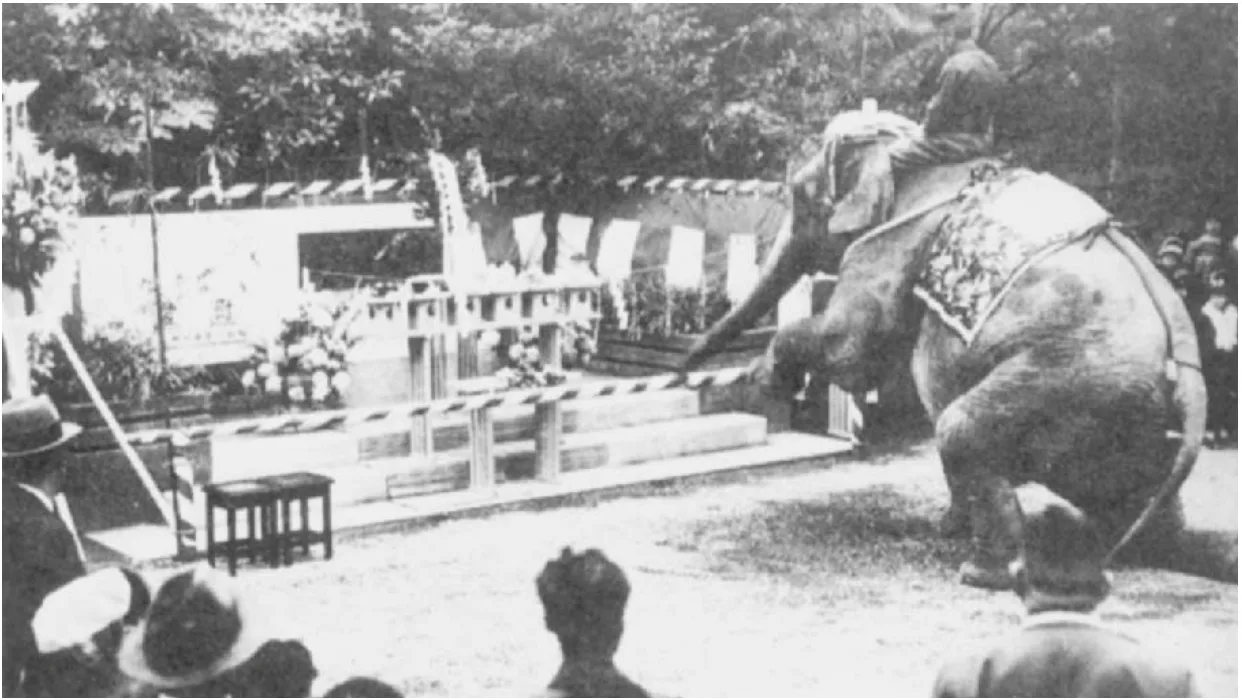
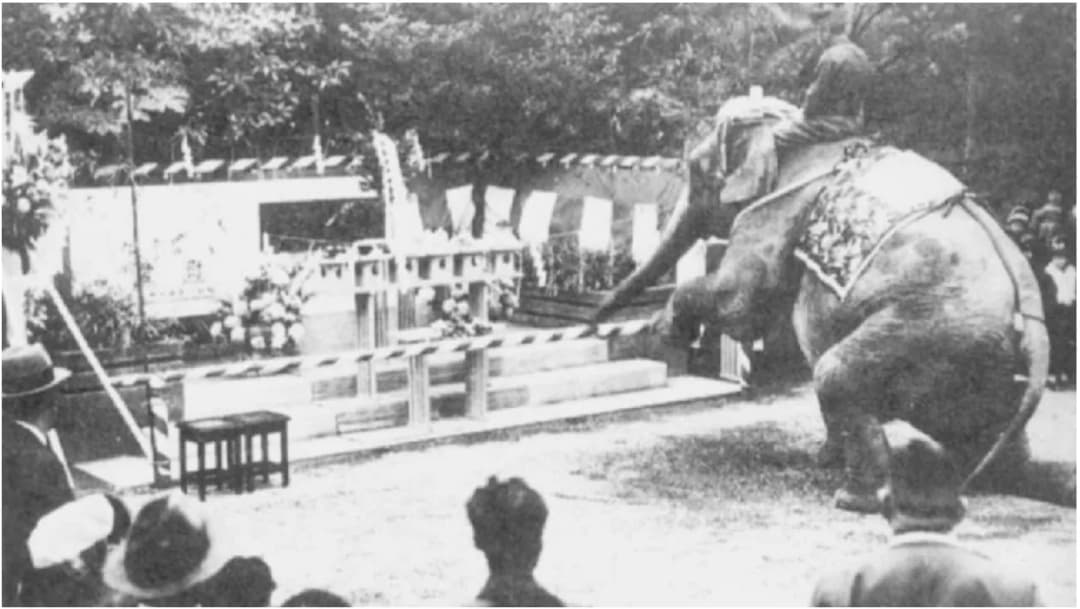
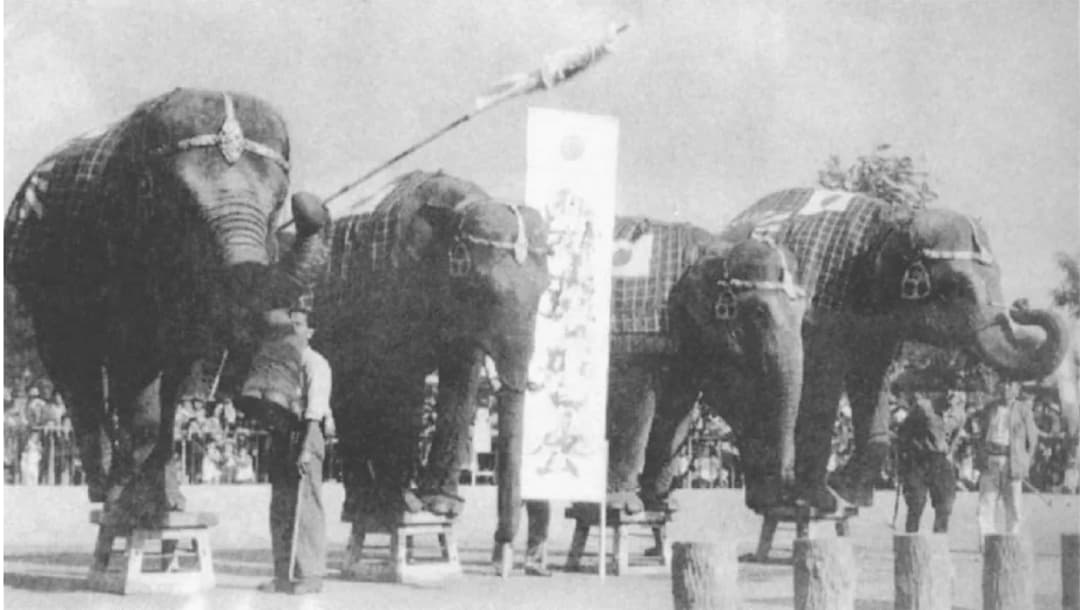
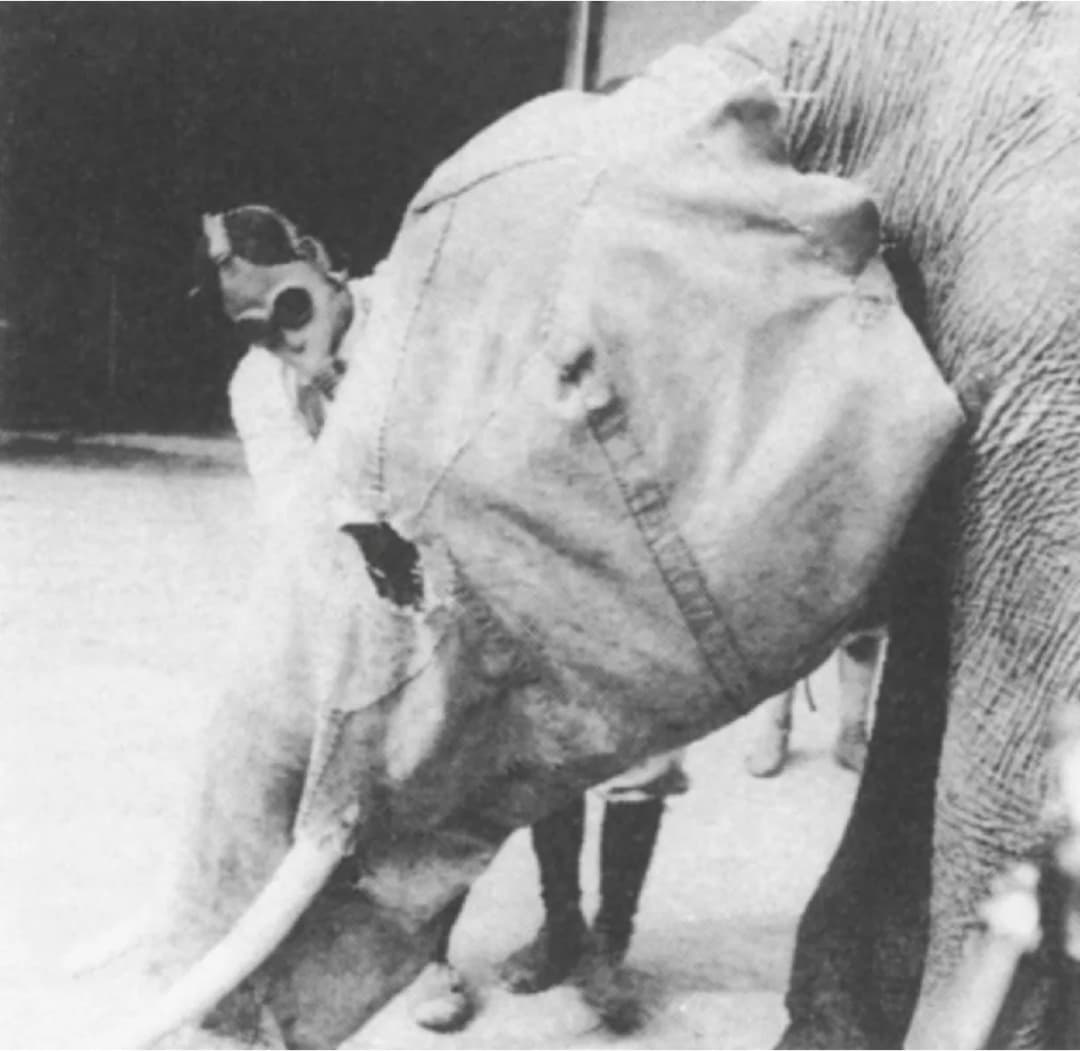
The killings came after years in which the government had turned zoos into stages for the war. From 1937 the Home Ministry used Ueno Zoo for patriotic exhibitions of military horses, dogs and pigeons, and for memorial services for fallen military animals. The elephants Tonki and Hanako were sent to perform for bereaved children at Yasukuni Shrine and made to kneel before the altar at services for military horses and dogs.
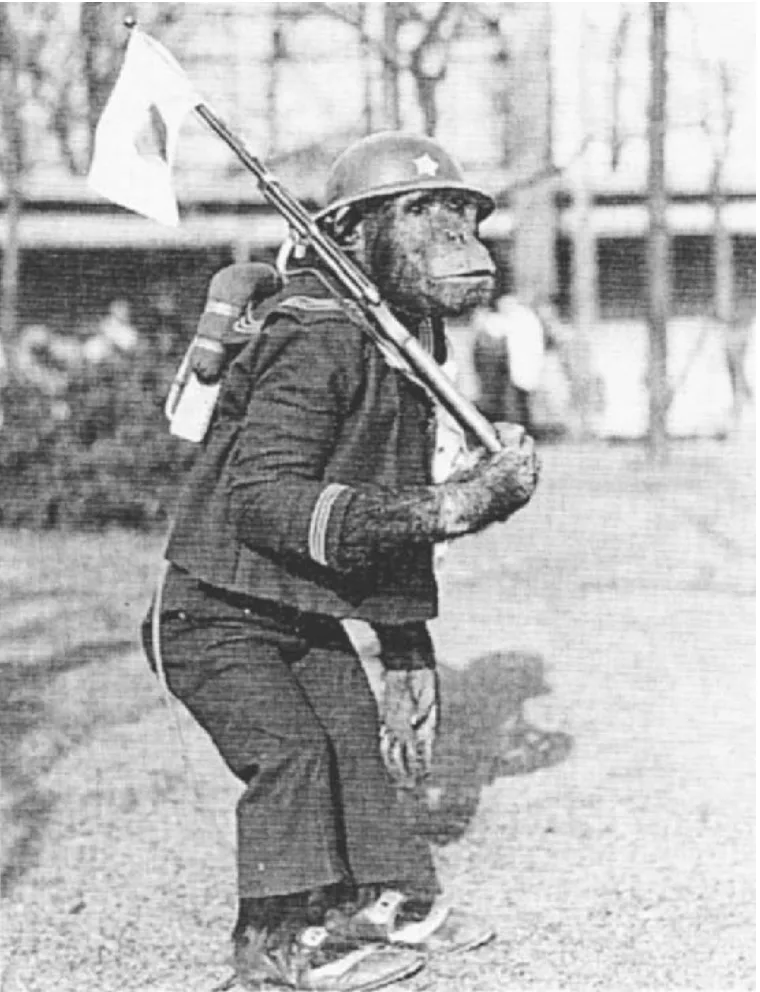
English names were banned. The chimpanzee Lloyd at Osaka became Katsuta ("victory boy"), and the elephant Kalyani at Kyoto became Tomoe, after the Greater East Asia Co-Prosperity Sphere. Osaka's celebrity chimpanzee Rita was dressed in a military uniform and made to carry a rifle with a flag. Zoos also had their iron fences, benches and animal labels taken for the war effort.
How the animals were killed
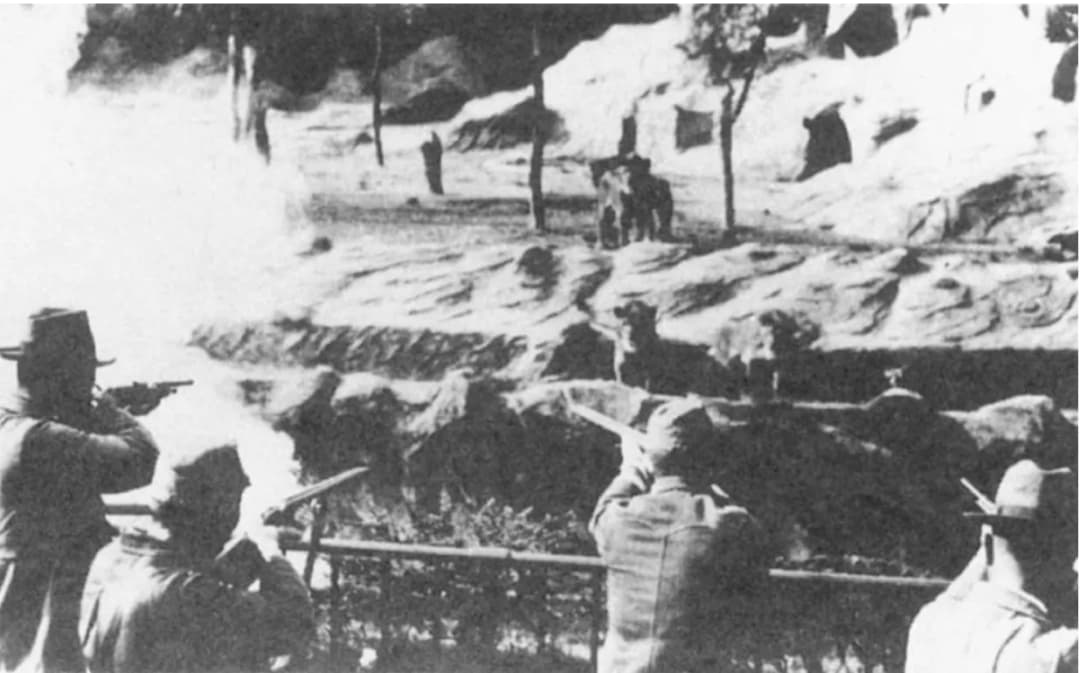
Ueno Zoo killed 27 animals of 14 species between August 17 and September 23, 1943, and the poison mostly did not work. The ban on guns, meant to keep the plan secret, forced the staff to kill in what Itoh calls "the cruelest fashion".
The zoo had only one employee licensed to handle drugs, and the keepers had never killed animals this way. They stopped feeding the targeted animals on August 16 so that hungry animals would eat poisoned food. The fallback plans were strangulation, then spearing.
The first week
On the evening of August 17, a keeper fed a female Siberian brown bear, a gift from Prince Takamatsu, steamed sweet potato mixed with three grams of strychnine nitrate. She ate it at once, convulsed within a minute and thrashed for 22 minutes before she died.
The next day the staff killed a lioness, a Korean black bear and a young leopard named Hakkō. An Army sergeant major had found Hakkō as a cub at the front in China, kept him as his unit's mascot, and sent him to Ueno because he thought the zoo was safe. Hakkō was two and a half years old. The sergeant phoned from the front in September to ask how the leopard was doing.
Date (1943) | Animals | What was actually done |
|---|---|---|
Aug 13 | John, Asian elephant | Food and water cut off; died Aug 29, the 17th day |
Aug 17 | Female Siberian brown bear; male Japanese black bear | Strychnine; the bear took 22 minutes to die |
Aug 18 | Lioness, Korean black bear, leopard Hakkō | Poison; bodies mounted or flayed |
Aug 19 | Male Siberian brown bear | Poison failed; speared with scalpels fixed to poles, died 1.5 hours later |
Aug 20–21 | Young Korean black bear; older Japanese black bear | Young bear: poison, then spearing. Older bear: strangled after fighting five men for about 45 minutes |
Aug 22 | Lions Ali and Katherina, a tiger, a cheetah | Ali died in 32 minutes; Katherina spat out the meat, then was speared through the heart after 1 hour 37 minutes |
Aug 24 | Female polar bear | Strangled; it took half an hour to get the wire loop around her neck |
Aug 26 | Rattlesnake | Pierced and strangled with wire; died after 16 hours |
Aug 27 | Python, two leopards, sun bear | Python strangled and beheaded; both leopards strangled but logged as poisoned |
Aug 29 | Male polar bear; American bison | Polar bear strangled by five keepers; bison strangled, then axed and hammered |
Sep 1 | Young American bison | Hammered |
The lions Ali and Katherina had been a gift from Emperor Haile Selassie of Ethiopia to Emperor Hirohito in 1931, and Ethiopian royal guards had escorted them to the port. The bison were from William Randolph Hearst's San Simeon estate, said to be the first bison to cross the Pacific.
What the zoo told the governor
The report Fukuda sent Ōdachi listed nearly every death as poisoning. He revealed the truth only in 1968, in a book, because most of the poisonings had failed. Keepers killed in the evening after closing and, because the bodies could not be kept in the August heat, hauled them by wagon the next morning to the Army Veterinary School in Setagaya for necropsy. Some were then mounted, and many were flayed.
On August 28 Fukuda prepared 140 pounds of tanning extract and 190 gallons of quicklime to flay an elephant, which takes about a month. The zoo hung signs saying that the dangerous-animal cages were "closed temporarily due to construction." The Tokyo government did not announce the killings until August 30.
When the mounted lions were later put back in their old cages, Itoh says they looked like toy stuffed animals. Goats and pigs were moved into the empty night cages.
The elephants
The three elephants at Ueno were not poisoned or strangled but starved, over 17 to 30 days, because nothing else worked. There had been about 20 elephants in Japanese zoos in the early 1940s. By May 1949 only two were left in the whole country.
John
John, a male from India, had arrived in 1924 with the female Tonki. He had a violent history: in 1931 he killed a circus trainer, Ishikawa Taijirō, who had prodded his forehead with a spiked ankus. His hind legs were chained even at night. Itoh also records that the zoo had controlled him with food deprivation, and that a keeper once burned hay under his belly.
Fukuda had permission to destroy John by August 11. Keepers gave him his favorite sweet buns with cyanide injected into some; he ate only the clean ones. A syringe meant for horses broke on his skin, and a second needle, at the base of his ear, broke too. The Army Veterinary School staff who had supplied the drugs gave up.
On August 13 the keepers stopped giving him food and water. On the seventeenth day, August 29, he collapsed and died. The Tokyo park section afterward used his elephant house to store 500 coffins for air-raid dead.
Tonki and Hanako
Tonki, who had come with John, was the zoo's most popular animal and Fukuda's favorite. Hanako had come from Thailand in 1935. The keepers Sugaya Kitsuichirō and Shibuya Shinkichi opposed killing the two females. Sugaya had agreed to John's killing but refused outright for them.
Fukuda tried to save Tonki. Sendai City Zoo, which had no elephant, agreed on August 11 to take her, and her transport was set for August 23. That day, Inoshita told him that Ōdachi was furious. Fukuda had also written to Osaka and Nagoya, and every attempt to move animals out failed.
The two elephants stopped being fed on August 25. When Fukuda went to the elephant house, a visibly thin Tonki stood on her hind legs and performed for him, expecting bananas. As they weakened, both slept standing against the bars, which elephants do when they know they cannot get up again. Fukuda closed the elephant house on September 7 because he could no longer watch.
Sugaya secretly fed them a little. At his funeral in 1950, his daughter recalled that he used to carry off the family's ration of sweet potatoes to somewhere she did not know, and she had thought he was eating them alone. They were for the elephants.
Hanako died of starvation and dehydration on September 11, the eighteenth day, with Tonki stroking her with her trunk. Tonki threw back the poisoned potatoes and refused water laced with cyanide. She died on September 23, the thirtieth day.
The zoo hung a black-and-white striped curtain over the elephant house, which looked like mourning and hid that the elephants were still alive. Inoshita had told Fukuda not to let Ōdachi know.
The hippopotamuses
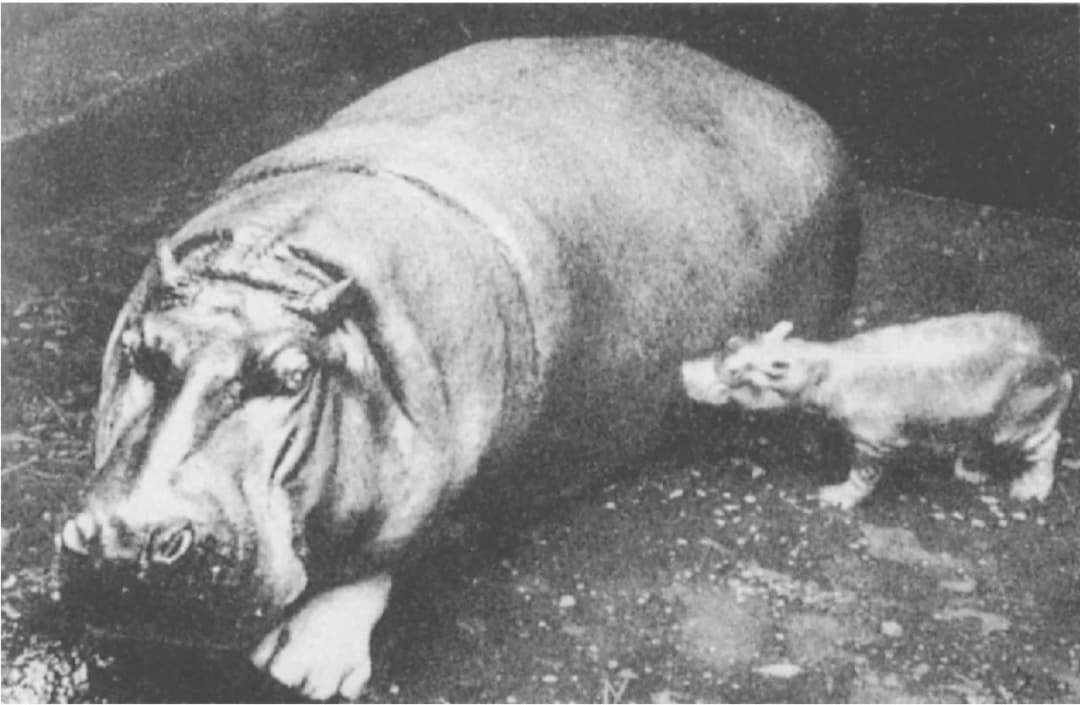
The two hippos at Ueno, Maru and his mother Kyōko, were not on the 1943 list. After the Tokyo air raids of March 1945 the zoo decided to destroy them too, citing the feed shortage. The keepers stopped feeding them on March 19 and drained their pool. Maru died on April 1, after 14 days without food or water. Kyōko lasted 37 days and died on April 24, the day a truckload of hay finally arrived. Itoh counts the hippos among the animals Ueno deliberately destroyed, which brings the zoo's total to 29.
The keepers, the children and the cover-up
The men who killed the animals were the men who had cared for them, and the records show how badly it affected them. Fukuda wrote in his journal that after the meeting where he got the order, he walked around the zoo in a light rain and the tigers and elephants came to the bars to rub against him. He could not look them in the eyes. The next morning he told the staff and ordered them to say nothing to anyone, including their families.
He lost 16 pounds in a month and had nightmares for years. Some keepers stayed home on the day their animal was to be killed. Sugaya and Shibuya were removed from keeper duty and made custodians. Shibuya, who had burned hay under John, said he carried the souls of the three elephants on his shoulders. He kept dreaming that Tonki was stepping on him.
Shibuya also said the keepers ate the meat of the dead animals so their deaths would not be wasted. Bison, elephant and hippo tasted terrible, he said, and the fatty alligator meat was the best. Itoh reports that some senior keepers took up heavy drinking after the killings. When Ueno bought a new hippo pair in 1952, the staff could not join the celebration.
Silence and a funeral
Tokyo announced the killings on August 30 as 27 animals, including three that were secretly still alive. The press was censored. The zoologist Takashima Haruo, who visited on August 31, found the cages shut with the construction sign, and learned the truth two days later. He thought zoo animals were not as dangerous as wild ones and posed little risk to people.
The zoo received a flood of protest letters, many from children, but by then it was too late. On September 4 Ōdachi held a funeral service at the zoo, with the grand priest of Sensō Temple invited to officiate. A dignitary's eulogy said the animals had "sacrificed their lives for the sake of Japan." Takamiya reports that Ōdachi himself proposed the service, saying that since they had done a poor thing to the animals, they should hold one.
The children of Osaka
Osaka City Zoo could not hide it from reporters. Director Terauchi Shinzō told the press in early September that the animals would be destroyed "in the near future" and, the next day, began. After the news appeared, he and the mayor received letters from schoolchildren and others begging them to evacuate the animals. A second grader whose teacher had taken the class to the zoo to see the animals one last time enclosed his allowance and asked that the animals be given a feast before they died. A fifth grader sent hers with a prayer that the animals would be reborn as herbivores so they would not be killed again.
A reporter at the Osaka Mainichi, Ueda Chotarō, criticized the policy in February 1944 under strict censorship by asking questions. Deer with antlers and bison could do as much damage as lions, he pointed out, and cautious big cats would hide in the backs of their cages in an emergency. He also noted that the keepers were too depressed to eat lunch after the killings.
Directors who resisted
Several directors tried to save what they could. Fukuda's attempts to evacuate Tonki, a leopard pair and a black leopard cub all failed. Osaka's longtime director Hayashi Saichi retired early in January 1943, and some speculated that he could not face what was coming. Kyoto's director argued with the police that its concrete night cages made escape unlikely, as a later section describes. Nagoya's director Kitaō Hideichi held out until December 1944. None of them could refuse.
The policy spreads
Within 16 months of Ueno, every member zoo of the national zoo association had destroyed its dangerous animals, with one possible exception, and the circuses were ordered to do the same. Itoh counts at least 170 confirmed animals from zoos and 133 from circuses, 303 in all, and says the real total is substantially higher.
Zoo | City | Began | Confirmed animals killed |
|---|---|---|---|
Ueno | Tokyo | Aug 17, 1943 | 29 (27 in 1943, two hippos in 1945) |
Osaka City | Osaka | Sep 4, 1943 | 26 (24 in one source) |
Inokashira Park | Tokyo | Sep 1943 | 6 |
Itōzu Yūen | Kokura | Sep 1943 | at least 2 |
Kamoike City | Kagoshima | Oct 6, 1943 | 15 |
Kumamoto City | Kumamoto | Jan 1944 | 16 (15 in 1944, plus the elephant Ellie in 1945) |
Takarazuka | Takarazuka | Mar 5, 1944 | many; no count |
Sendai City | Sendai | about Mar 1944 | 12 |
Kyoto City | Kyoto | Mar 13, 1944 | 14 |
Fukuoka City | Fukuoka | Jun 6, 1944 | at least 3; the rest uncounted |
Kobe City | Kobe | Jul 1944 | 24 |
Ritsurin Park | Takamatsu | about late 1944 | at least 1; the rest uncounted |
Higashiyama | Nagoya | Dec 13, 1944 | 15, plus 3 earlier |
Kōfu City | Kōfu | unclear | records contradict each other |
The figures are Itoh's, taken from the zoos' own histories, city records and newspapers. A fifteenth zoo, Hanshin Park near Osaka, was a private zoo that sold off its animals in April 1943 before the order, and is not in the table. Three zoos in Korea, Taiwan and Manchukuo are also known to have destroyed animals.
Waiting to see
After Ueno the zoo directors met in Kobe, but only six of the fourteen attended and Fukuda was absent. They hoped to avoid Ueno's fate because their cities were not the capital, and decided to reinforce cages, run air-raid drills with smoke emitters for realism and reassure the public that no animal would escape.
Osaka
Osaka City Zoo started on September 4, one day after its director told reporters the killings would come "in the near future." The writer Akiyama Masami, whom Itoh cites, found the speed suspicious, since there was no ultimatum of the kind Ueno received. The zoo destroyed 26 animals between September 1943 and March 1944, mostly by poison hidden in scarce beef, though a leopard that refused it was strangled.
The animals were valued by the zoo, and Itoh lists the prices. A polar bear was worth ¥1,500 when people earned under ¥100 a month, and the zoo kept a female polar bear until March 1944. Director Terauchi lost 11 pounds in the days before the first killing.
Kyoto
Kyoto had expected to be spared because its concrete night cages were strong and the city was not expected to be bombed. Director Hara Ken'ichi told police there was no need to kill anything, and even bought a female elephant and a giraffe from Hanshin Park Zoo in April and May 1943.
Then on March 12, 1944, an Army chief of staff arrived unannounced for a drill and ordered the zoo to destroy its dangerous animals at once, at 3 p.m. Hara begged for a day. The next day staff shot a brown bear and its mother in front of the chief of staff, police and city officials. Twelve minutes later the son stood up again. The staff, who had not checked, left both bears overnight. They were still alive in the morning and were strangled with wire rope. Fourteen animals died between March 13 and 25.
Nagoya
Higashiyama Zoo's director, Kitaō Hideichi, resisted longest. In November 1943 the zoo destroyed an Ezo brown bear by poison and a lion by strangling as "experiments." He managed to donate two lions to Zhangjiakou in China, and a lion was sold to a local hunters' club for shooting practice.
On December 13, 1944, B-29s struck Nagoya. About fifty members of the Hunters Volunteer Corps gathered at the Chikusa police station and waited for the Home Ministry's order, which arrived while the city burned. They surrounded Kitaō at the zoo. He told them to go ahead, with tears running down his face, and stayed in his office. The hunters shot two leopards, a tiger and four lions within 45 minutes. These were the last lions in Japan, and the country had none again until 1949.
A few days later the hunters came back for the bears. Kitaō, this time made to come along, coaxed a Japanese black bear to stand on its hind legs so they could aim at the white crescent on its chest. It stood expecting to be fed. All eight bears were shot that day. Kitaō dreamed about it for years.
When the hunters wanted the four elephants next, Kitaō went to the Army headquarters and police station every day, said the elephants were domesticated, and agreed to chain them. He said that if they were to be killed, he should be killed first, or words to that effect. The authorities stopped short of ordering it. Two of the four survived the war.
Sendai and the circuses
Sendai City Zoo was losing money and the city considered turning it into a farm. Under growing criticism, it destroyed 12 animals in the spring of 1944.
Circuses got a week. On October 21, 1943 the police agency told 28 circus groups to destroy their dangerous animals by 10 a.m. on October 28. They killed 133 animals, either by poison or gun: 52 lions, 8 leopards, 2 tigers, 6 bears, 7 elephants and 58 snakes. The animals were the circuses' livelihood, and Itoh writes that it was as if their hands and legs had been ripped off.
Fukuoka and Kyushu
Fukuoka's zoo in East Park was emptied nine months after Ueno, and it is one of the least documented. Itoh notes that Akiyama Masami's 1995 book, the main Japanese study of the subject, leaves out Kyushu altogether, so Fukuoka's story has had little attention in either language.
Date | What happened |
|---|---|
Nov 1928 | A committee to mark the Shōwa Emperor's enthronement is set up and a zoo and botanical garden is planned |
Mar 1932 | East Park is chosen as the site |
Sep 28, 1932 | Ground-breaking ceremony held in East Park |
Aug 20, 1933 | The zoo opens |
Apr 11, 1934 | The formal opening ceremony takes place, attended by the mayor and council chair |
May 20, 1944 | The zoo closes |
Jun 6, 1944 | The large animals are destroyed |
Jun 7, 1944 | A memorial service is held |
Jun 19, 1945 | U.S. air raids burn central Fukuoka |
1949–1950 | The city council approves a new zoo and picks South Park |
Aug 22, 1953 | The new zoo opens in South Park, today's Fukuoka City Zoo |
Sources: Fukuoka City Zoo history, City Council history, vol. 3, and Itoh.
Building the zoo
The city council's own history says the zoo took almost five years from the first proposal in 1928. Raising money, renting East Park land from the prefecture, local support and opposition, and a rethink of the site all slowed it, and tree felling in the park delayed construction. Citizens paid for much of it, and the library's exhibition on the old zoo says it was comparable to the zoos of Tokyo and other large cities.
What the zoo had
According to the zoo's own history page, the site covered 5,096 tsubo and cost ¥150,000. It had 38 animal buildings and more than 100 plant species. At opening it held 164 mammals of 65 species and 500 birds of 124 species, plus reptiles, amphibians and fish. About 5,000 people came on the first day, and it drew roughly 150,000 visitors over 134 open days that first year. Adults paid 15 sen and children 10, and soldiers in uniform paid 10.
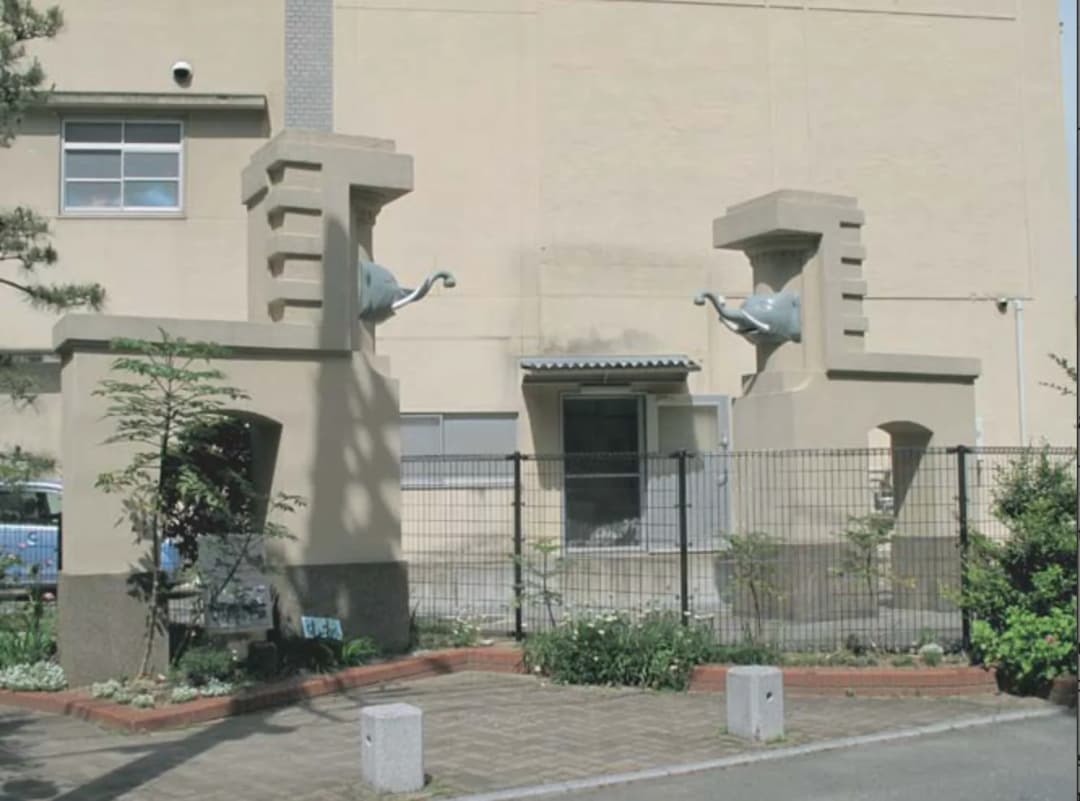
Itoh puts the collection at about 700 animals, including lions, elephants, and sea lions and fur seals, which were rare in Japanese zoos then. The front gate was modeled on the Hagenbeck Animal Park in Hamburg, with elephant trunks reaching out from the pillars on each side. The hexagonal pavilion at the sea lion pond is the Ukimi-do now in Ohori Park.
Closing and the killing
The zoo closed on May 20, 1944, because feed was hard to find and bombing might destroy the animal houses, according to the library's exhibition. On June 6 the large animals were destroyed, and a memorial service for the dead animals was held the next day.
That is nearly all the record says. The zoo's official 50-year history states only that it "disposed of lion(s), tiger(s), hippopotamus, and others." It gives no total, no list and no method, and Itoh's table can only list "3 + many." Itoh also points out that the zoo's own website shows a 1933 photo of at least three elephants, yet no record says what became of them. The sea lions and fur seals go unmentioned too. At Kumamoto the seals and sea lions starved, and the same may have happened here, but nothing I found says.
After the war
Fukuoka's city center burned in a U.S. air raid on June 19, 1945. After the war, children and citizens kept asking for the zoo back. The city council voted unanimously in 1949 to build one as a project for the city's 60th anniversary, and chose South Park the next year. The mayor from April 1951, Konishi Haruo, sought help from local business and took advice from the director of Ueno Zoo. In November 1952 donations of ¥28 million came in, and the new zoo opened on August 22, 1953 with 69 species and 143 animals. In the gap, the newspaper Nishinippon Shimbun's welfare fund staged a small-animal zoo on the roof of the Tamaya department store for waiting children.
The other Kyushu zoos
Itōzu Yūen (Kokura). The railway-owned zoo was closed on January 10, 1944 so the prefectural police corps could use it as headquarters. Its wartime director, Anami Tetsurō, told the story twice and changed it. In 1950 he said staff stabbed a hyena with a Japanese sword and that an elephant given to a circus was destroyed in Korea. By 1975 the hyena had just died of injuries and the elephant had died during a performance. He also wrote that the zoo had poisoned a bear and that the last male lion died of natural causes, which Itoh reads as a sign the lion would have been destroyed anyway. She suggests his remorse may explain the change, and says no one would have blamed him.
Kamoike (Kagoshima). The zoo killed 15 animals, among them 2 lions, 7 bears, 4 alligators and 2 pythons, between October 6 and 31, 1943. Strychnine failed because the animals sensed something and refused the food, so staff connected high-voltage current from a nearby streetcar line and electrocuted them early in the morning before the trains ran. The keepers could not bring themselves to kill the alligators and tried to save them in a cart. One escaped and caused a commotion on the street. A memorial service followed on November 6.
Kumamoto. Army orders came in December 1943. The director, Hayashi Rokurō, chose electrocution over the poison and shooting other zoos used. On the first tiger, a keeper held out meat on a bamboo pole wired to the power. The tiger looked at him gently, he could not stand it and ran, and the switch was thrown when the tiger leapt for the meat. In all, 15 animals died in 1944: three tigers, two lions, two Japanese black bears, three other bears, two leopards and three wolves. The director saved the python, the hippopotamus and the elephant Ellie by arguing they were not ferocious.
It was only a delay. Hayashi was drafted on January 7, 1945, and the hippo starved the same day. The sea lions and fur seals starved, the pythons died of cold and the zoo closed on March 31. In April the Army told the new director it would take Ellie, then ten years old, and decided to kill her to feed soldiers, most likely in mid-May. When she refused to enter an electrified pool, they gave her potatoes on a stick wired to the current. Her body was dissected in the pool, and the water ran red for a very long time. Her keeper, Kanazawa Tarō, had treated her as a daughter and stopped talking about her. By the end of the war, almost none of the zoo's 1,600 animals remained and three staff were left.
Was it necessary?
No. Itoh's assessment is that the killings were unnecessary for public safety, and the air raids that followed prove it: not one cage was broken open anywhere in Japan.
Ueno came through the March 1945 Tokyo raids intact. The only damage the zoo took, on April 13, 1945, was that the elephant house burned, with the 500 coffins stored in it. The dangerous-animal buildings were untouched.
Osaka was hit by about 2,000 incendiaries on March 13–14, 1945. Seventeen facilities burned and 33 birds died, but none of the dangerous-animal buildings were damaged.
Kyoto was never heavily bombed.
Nagoya had no damage to dangerous-animal buildings on December 13, 1944 or when the zoo was hit on February 15, 1945. The only animal to get loose was a bison in an open enclosure, shot immediately.
Itoh's summary is that no ferocious animal escaped its cage during the air strikes, because there were no animals left. Directors such as Kyoto's Hara and Nagoya's Kitaō had argued that reinforced cages would hold and that a bomb hitting a cage would kill the animal inside, and the Osaka Mainichi reporter pointed out that frightened big cats hide rather than attack. A black leopard that got out of Ueno in 1936 had stayed hidden.
What other countries did
Zoos elsewhere also killed animals in the war, but not like this.
London Zoo began destroying animals in September 1939, a year before the Blitz, but England was already at war and the decisions were the zoos' own.
Belfast Zoo destroyed its animals during the Blitz of April 1941.
Berlin Zoo and Hagenbeck's park in Hamburg destroyed animals after being attacked.
U.S. zoos such as the Bronx and Philadelphia drew up contingency plans, but left the decision to the zoo or its society.
Itoh found no other country that carried out a nationwide, systematic policy, and no European zoo that killed its animals so far ahead of expected raids. Some German and Dutch zoos may have acted on military orders, but not uniformly across the country. She calls Japan's case extraordinary and unique.
What it was for
Itoh reads the animal killings as the first of Ōdachi's measures to mobilize civilians. In 1944 he went on to evacuate schoolchildren from Tokyo and to have buildings torn down as firebreaks, and the Home Ministry and military extended both policies nationwide. Whether the killings changed anyone's mind, she does not say. By her assessment, they added nothing to public safety.
Afterward
The man who gave the order was never tried, and the animals were never accounted for. Most of what is known came out decades later, and sometimes only in pieces.
Ōdachi
Ōdachi became home minister in July 1944 and resigned in April 1945. The Occupation authorities ordered him jailed as a war-crimes suspect, and he entered Sugamo Prison on December 16, 1945. He was released on August 31, 1947 without being tried, largely because he had refused to join Prime Minister Konoe's wartime single-party Imperial Rule Assistance Association. He was purged from public office in 1946 and freed from the purge in 1952.
In 1953 he was elected to the upper house and appointed education minister, where he pushed through bills restricting teachers' political activity in 1954. He died of stomach cancer in September 1955, aged 63. His prison diary says nothing about the animals.
The truth took years
Fukuda told the true story of Ueno only in 1968, a quarter century later. Anami of Itōzu Yūen told it one way in 1950 and another in 1975. Many zoo histories give no dates, no numbers, or contradict each other. When Itoh asked a senior staff member at Nagoya's zoo in 2008 about wartime records, he said the zoo had none and knew nothing. She notes that city officials rotate through zoo posts every few years, and many of the people who did the work have died.
After the war the government also shifted blame for wartime excesses onto the military, and Komori Atsushi stresses that for the zoo killings there was no military order.
Memorials
Most zoos held memorial services during the war and put up memorial stones, in the Buddhist custom. Itoh thinks these mainly eased the guilt of the people who did the killing and did little for the animals, and she notes that the Kyoto veterinarian Takizawa Akio found the services hypocritical.
Eldo and Makani, and the Elephant Train
By the end of the war only a handful of elephants remained, and in May 1949 the only two in Japan were Eldo and Makani at Nagoya's Higashiyama Zoo. That month two Tokyo schoolchildren, representing the Taito Ward children's congress, traveled to Nagoya to ask Kitaō to lend one to Ueno Zoo. He took them to the elephant house, separated the two animals behind an iron door, and let the children watch. Makani rammed the door until her forehead bled. Kitaō said that showed how inseparable they were, and declined.
Instead he asked for children to come to the elephants. The Occupation authority controlled Japan's railways and would not allow extra trains, so railway staff had to ask repeatedly before approval came. The first "Elephant Train" left Hikone on June 18, 1949 with about 1,400 children, and one left Ueno on June 26 with about 1,150. In all it brought 15,000 children to Nagoya, through cities that were still ruins.
Makani died in September 1963 at about 66 and Eldo followed in October at about 58. The zoo holds a memorial service for them every year during Animal Week, and a memorial stone stands in the grounds.
What remains in Fukuoka
The Ukimi-do in Ohori Park is the surviving building from the East Park zoo's seal pond.
The elephant-gate pillars are preserved in a corner of the schoolyard at Maidashi Elementary School, according to the City Library. It is a working school, so ask before visiting.
Fukuoka City Zoo in South Park, which opened in 1953, is the successor to the East Park zoo.
What we still do not know
Most of the open questions are about Fukuoka itself, and sources disagree on some basic dates.
How many animals Fukuoka's zoo destroyed, of which species and by what method. The zoo's 50-year history lists only lions, tigers, a hippopotamus "and others."
What happened to the elephants in the zoo's 1933 photo, and to its sea lions and fur seals.
When the pavilion moved. Ohori Park's official site and the city's cultural-properties pamphlet say 1949. The City Library's exhibition says 1974. The sources also differ on whether the pond held fur seals or sea lions.
When the zoo opened. The city council history and the zoo's own page say August 20, 1933, with a formal ceremony on April 11, 1934. Itoh says June 1933. She also dates the new zoo's opening to June 1953, where the zoo's own page says August 22.
Whether Fukuoka has a memorial to the animals. I did not find one.
Ōdachi's own reasoning. He left no writing on it, and the Johor Zoo link is Itoh's inference, not a documented fact.
Where to look next
The Fukuoka City Council history, vol. 3 (Fukuoka-shi gikai-shi), whose zoo chapters are online and cover the zoo's founding and life.
The zoo's 50-year history (Fukuoka-shi dōbutsuen 50-shūnen kinenshi, 2003), which Itoh cites for the 1944 killings.
An Asahi Shimbun article of May 22, 2007 on the former zoo's front gate site, cited by Itoh.
Fukuoka kindai emaki (Fukuoka City Museum, 2009), the source of the East Park zoo photo in the city's cultural-properties pamphlet.
Old postcards of the zoo in the Fukuoka City Library's collection.
Sources
Main source: Mayumi Itoh, Japanese Wartime Zoo Policy: The Silent Victims of World War II (New York: Palgrave Macmillan, 2010), DOI 10.1057/9780230117440. Chapters 1–6 and 9–10 and the appendix chronology are the basis for the national account. Most of the quotations and the keepers' testimonies come from the zoo directors' and keepers' own writings as cited by Itoh, including Fukuda Saburō's Jitsuroku Ueno dōbutsuen (1968).
Fukuoka sources:
Fukuoka City Zoo, "Fukuoka-shi dōbutsuen no rekishi": the zoo's chronology, including the 1933 opening figures, the June 1944 killings and the 1953 reopening.
Fukuoka City Library, "Dōbutsuen kaien no rekishi" exhibition (2015): the elephant gate, the closing, the postwar revival.
Fukuoka City Council history, vol. 3, ch. 12 (part 2) and part 1: the zoo's founding and opening dates.
Fukuoka City, "Rekishi no kaze" no. 34, on Ohori Park's history: the Ukimi-do's origin, 1949 move and 2014 registration.
Ohori Park official site: the 1949 move from the fur seal pond.
Further reading: Frederick S. Litten, "Starving the Elephants: The Slaughter of Animals in Wartime Tokyo's Ueno Zoo", The Asia-Pacific Journal (free to read), and Akiyama Masami, Dōbutsuen no shōwa-shi (1995).
Figures and dates come from these sources as of October 2026. Where sources disagree, the text says so.