Hakata Gion Yamakasa
When
Early–mid July· In 321 days
Where
Fukuoka
One of Japan's most famous and energetic festivals, held every July in the Hakata district of Fukuoka. It's centered on Kushida Shrine and is a Shinto ritual dedicated to Gion-sama, praying for protection from disease and for the community's health. It's a nationally designated Important Intangible Folk Cultural Property and was added to UNESCO's Intangible Cultural Heritage list in 2016.
Tradition traces it to 1241, when a Buddhist monk named Shoichi Kokushi is said to have ended a plague in Hakata by being carried through the streets on a platform while sprinkling holy water. The floats used today are said to descend from that platform.
The floats — two types:
Kazariyama (decorative floats): About 10 meters tall, displayed at roughly 14 locations around Fukuoka City from July 1st. These are purely for viewing — too tall to move under power lines since the Meiji era.
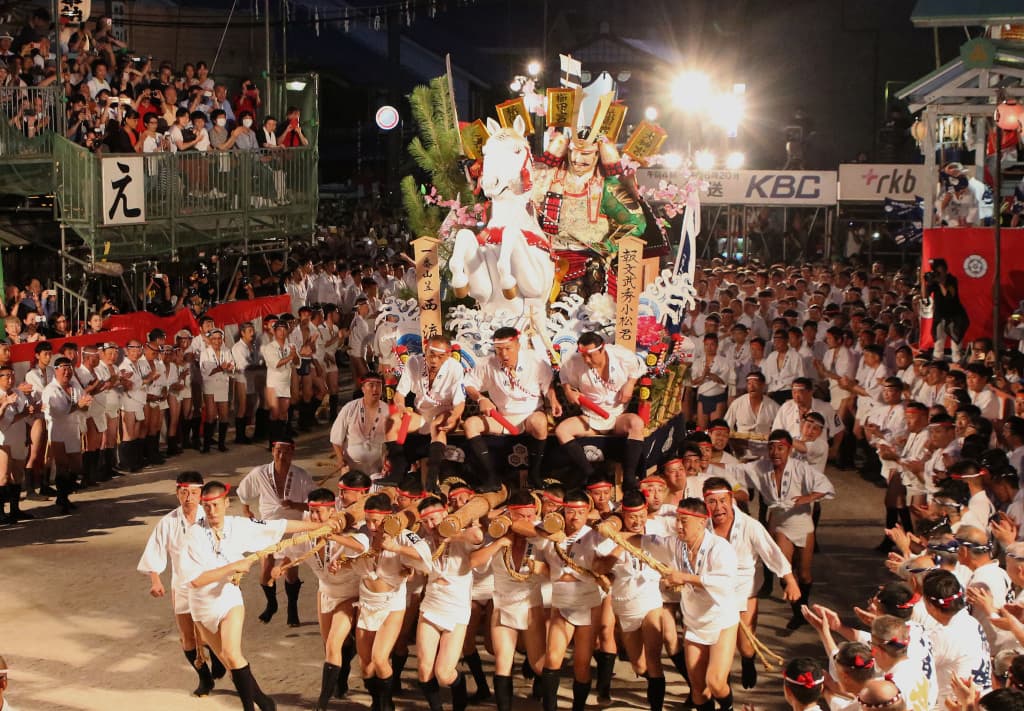
Kakiyama (carrying floats): The ones actually raced — around one ton each, no wheels, carried entirely on the shoulders of teams of men.
Structure of the festival (roughly July 1–15):
July 1 – decorative floats unveiled
Mid-festival – various practice runs and neighborhood parades (Nagaregaki)
July 12 – Oiyama Narashi (full-dress rehearsal)
July 13 – Shuyama, floats paraded through central Fukuoka
July 15, ~4:59am – Oiyama, the main event: seven teams representing different Hakata neighborhoods race a 5km course starting at Kushida Shrine, departing in 5-minute intervals, timed for speed.
On race day: Men wear traditional happi coats and fundoshi loincloths, chanting "Wasshoi, Wasshoi!" as they haul the float through the streets, taking turns carrying the immense weight, swinging hard around corners while spectators throw water to cool them. It draws up to a million spectators.